TC RAZOR 2025 IN REVIEW
TC Razor 2025 in Review: Sharpening Critical Thinking through Creativity and Collaboration
Adriana Pulley, Dominika Kunach, and Marko Kyrylchuk
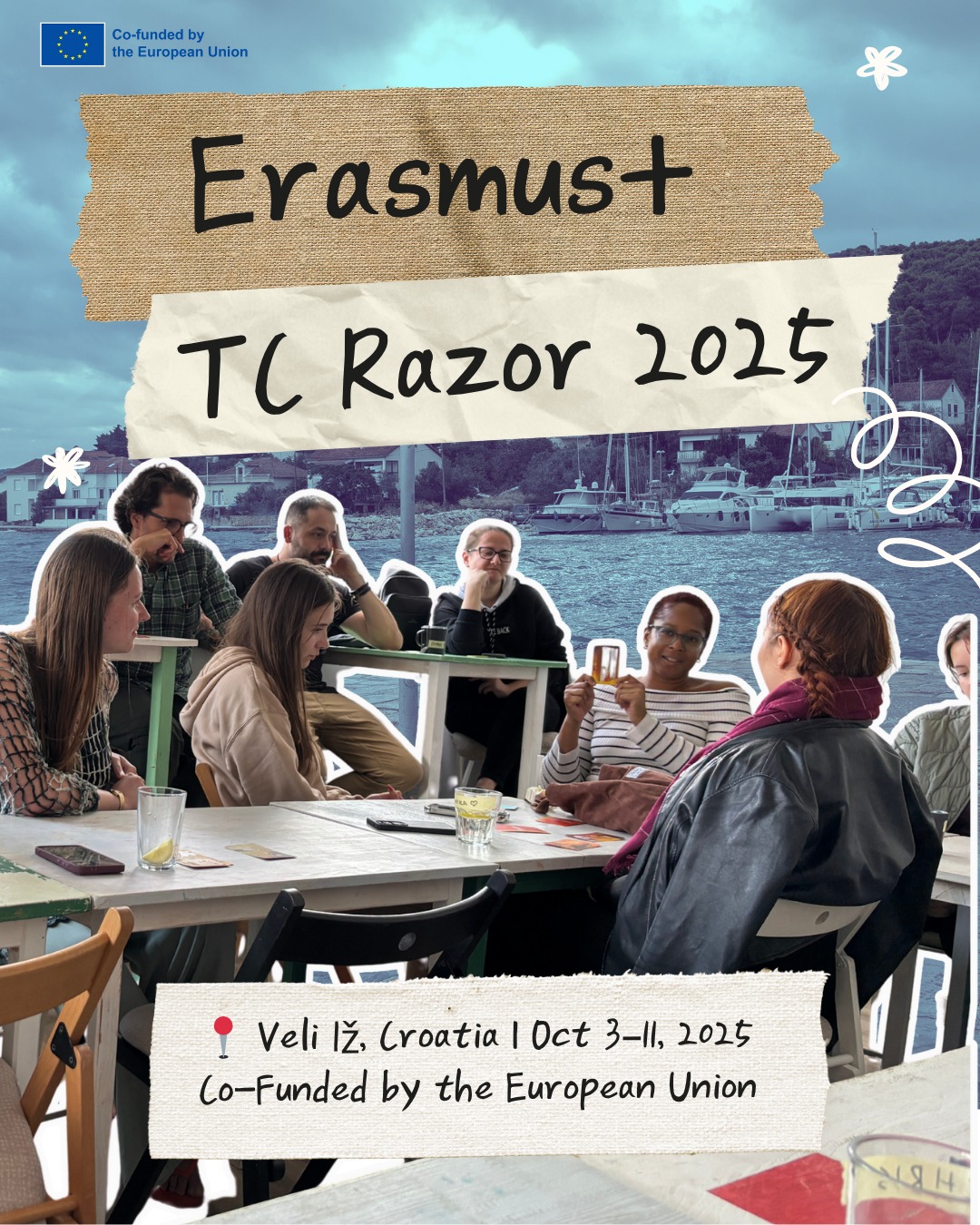
From October 3 to 11, 2025, youth workers from Poland, Croatia, Bulgaria, Spain, Latvia, the Netherlands, and Serbia gathered on the island of Veli Iž, Croatia, for Razor 2025, a training course organized by Udruga Prizma and co-funded by the Erasmus+ Programme of the European Union.
The program focused on critical thinking, disinformation, and non-formal tools for youth work in today’s “information age.”
Exploring the Core of Critical Thinking
Throughout the week, participants engaged in dynamic workshops, games, and discussions exploring logical fallacies, cognitive biases, and conspiracy theories. These sessions combined analytical exercises with creative storytelling, role-plays, and problem-solving challenges that helped transform abstract ideas into practical tools.
Key activities like the Percipio Game and thematic debates encouraged us to question assumptions, reflect on how we process information, and learn to facilitate these skills in our own communities.
Learning through Culture and Connection
The intercultural evenings, island walks, and small-group exchanges highlighted cultural awareness and citizenship competence, deepening our understanding of how different backgrounds shape the way we interpret truth and reality.
Participants found that empathy, curiosity, and humour often serve as the best starting points for dialogue across perspectives.
Methods that Inspire Learning
The training used non-formal education methods such as:
● Educational games and simulations
● Group reflection and Youthpass journaling
● Role-play and creative writing
● Open Space for sharing good practices
These participatory methods fostered collaborative learning and peer exchange, creating an environment where everyone could contribute their own insights and approaches to youth work.
Competences Strengthened
Participants enhanced several Youthpass Key Competences, including:
● Digital competence – detecting manipulation in media and online narratives.
● Citizenship competence – fostering responsible dialogue and participation.
● Cultural awareness & expression – using art and creative methods to spark reflection.
● Personal, social & learning-to-learn – recognising bias and managing emotional responses.
Reflections and Takeaways
For many of us, the most striking realisation was how easily biases influence our thinking and how essential it is to approach information with both logic and empathy. The emotional impact of role-play exercises revealed that critical thinking is deeply human.
The experience has transformed how we approach our professional lives in media, education, and tech. We’ve gained practical tools and frameworks to help others develop awareness, question assumptions, and engage thoughtfully with information in our digital world.
The outcome of the training course is a brief guidebook about Critical Thinking, which is available to download HERE
Views and opinions expressed are those of the author(s) only and do not necessarily reflect those of the European Union. Neither the European Union nor the granting authority can be held responsible for them.